
Academy › Single Essential Oils › Blue Tansy
Blue Tansy Essential Oil
The Indigo Oil of Quiet Evenings
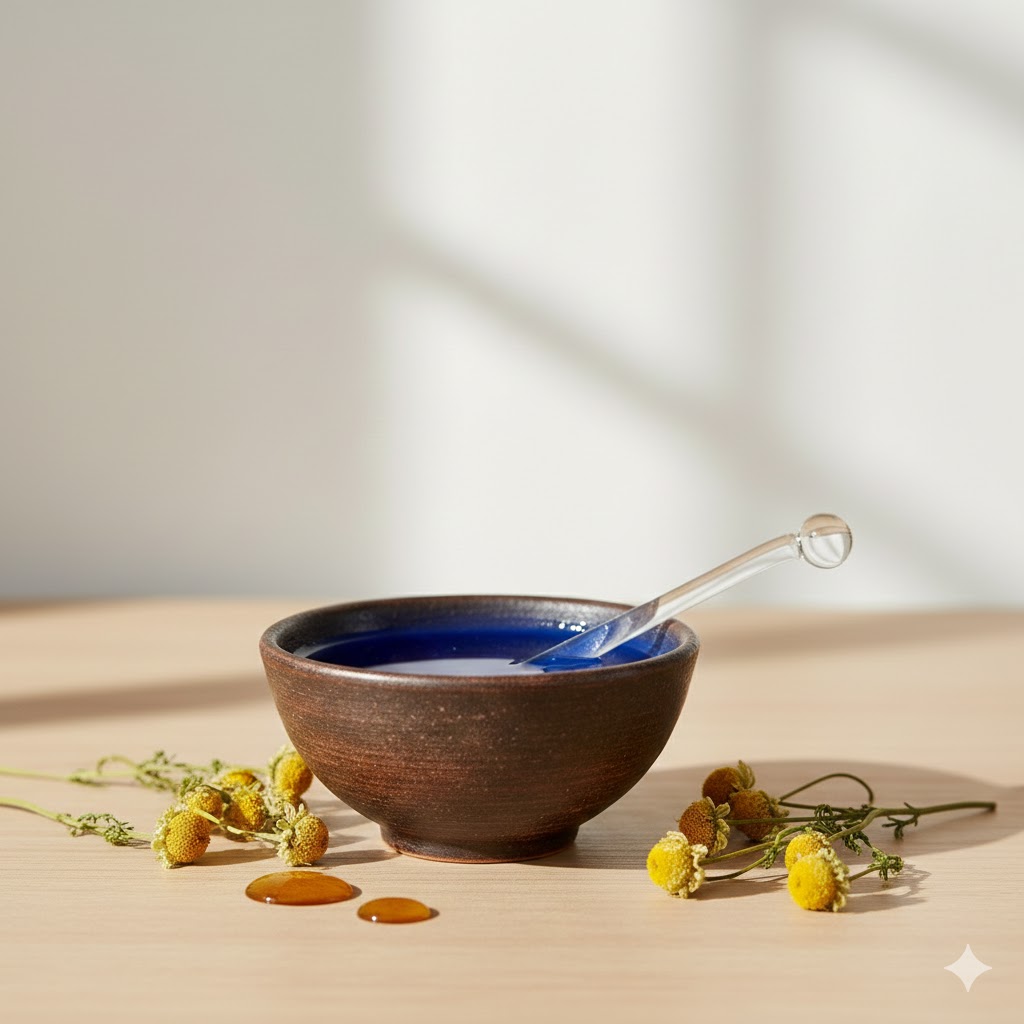
Blue tansy essential oil is a rare, deep cobalt-blue oil steam-distilled from the small yellow flowers of a Moroccan annual plant, loved for its sweet, fruity and herbaceous aroma and its place in calming evening rituals and gentle skincare blends.
Botanical name: Tanacetum annuum
Aroma: Sweet, fruity, herbaceous and mellow, with a soft camphorous edge
Note: Middle
Main growing region: Northern Morocco
Typically extracted: Steam-distilled from the flowers
Blends well with: Lavender, Frankincense, Geranium, Cedarwood and Sandalwood
Top 3 benefits:
- A calming evening scent: its sweet, mellow aroma is a favourite for winding down at the end of a busy day.
- Gentle skincare blends: traditionally used in small amounts in well-diluted facial oils and luxury beauty rituals.
- Rounding note in blends: a creamy, apple-like sweetness that softens sharper herbal and citrus oils.
Safety first: blue tansy is a potent oil, so keep skin use to 1% or less, patch test first, and avoid it during pregnancy, with epilepsy, and around young children and pets. Read the full safety information.
What Is Blue Tansy Essential Oil?
Blue tansy essential oil comes from Tanacetum annuum, an annual plant native to the western Mediterranean and best known from northern Morocco. It is sometimes called annual tansy or Moroccan chamomile. It should not be confused with common tansy (Tanacetum vulgare), a different plant with a different profile. The oil is steam-distilled from the tiny yellow flowers, and it is a relatively rare and precious oil.
The flowers are yellow, but the oil is a striking deep blue. That colour comes from chamazulene, which forms from a natural compound in the plant during distillation. Alongside it, the oil typically contains sabinene, myrcene and camphor, and the exact balance varies from batch to batch. The result is a sweet, fruity, herbaceous middle note that is distinctive on its own and very easy to blend.
Benefits and Traditional Uses
The science: blue tansy is traditionally prized in beauty rituals for sensitive-looking skin, and its chamazulene content has shown anti-inflammatory activity in laboratory studies. Research on the whole oil on human skin is limited, so treat it as a luxurious, gentle addition to a routine rather than a treatment for any skin condition.
How to use (the night serum): add 1 drop of blue tansy to 15ml of jojoba or rosehip oil (about 0.3%) and smooth a small amount over clean skin in the evening. Patch test first and keep away from the eyes. The blue colour can tint skin and fabric, so use sparingly.
The science: many people find the sweet, mellow aroma of blue tansy relaxing, and it is traditionally used as part of an evening wind-down. Aromatherapy research is limited, so think of it as a pleasant ritual that signals the end of the day.
How to use (the wind-down): diffuse 2 drops with 2 drops of Lavender in the bedroom for 30 to 60 minutes before bed, in a well-ventilated room, or put 1 drop on a tissue and inhale gently.
The science: in natural perfumery, blue tansy is valued as a middle note with a creamy, apple-like sweetness that rounds off sharper herbal and citrus oils. A very small amount goes a long way.
How to use (the soft blend): add 1 drop of blue tansy to a diffuser blend of 3 drops Frankincense and 2 drops Geranium for a warm, floral evening scent.
How to Use Blue Tansy Essential Oil
| Method | Instructions | VivaForte tip |
|---|---|---|
| Diffusion | 2 to 3 drops in an ultrasonic diffuser, in short sessions in a well-ventilated room. | A little goes a long way. Keep pets out of the room. |
| Inhalation | 1 drop on a tissue or cotton ball held nearby. | Do not inhale directly from the bottle for long periods. |
| Topical | Maximum 1% dilution (about 3 drops per 15ml of carrier oil). | Patch test first. The deep blue colour can tint skin and fabric. |
| Skincare | 1 drop in 15ml of jojoba or rosehip oil (about 0.3%) as an evening facial oil. | Use a small amount and avoid the eye area. |
| Blending | 1 drop added to a diffuser blend as a sweet middle note. | Pair with lavender, frankincense or geranium. |
Blue Tansy Safety Information
- Dilute and patch test. Use no more than 1% on the skin (about 3 drops per 15ml of carrier oil). Blue tansy may cause an allergic skin reaction, so patch test first and stop using it if irritation occurs. Avoid broken or sensitive skin. The blue colour can stain skin, fabric and light surfaces.
- External and aromatic use only. Do not swallow essential oils. Blue tansy is not for internal use.
- Pregnancy, breastfeeding and health conditions. Avoid during pregnancy and breastfeeding, and avoid if you have epilepsy, unless a qualified practitioner advises otherwise. Some sources also advise caution with liver conditions and hormone-sensitive conditions, and some report possible interactions with certain medicines. Speak to a healthcare professional before use.
- Children. Keep out of reach of children. Avoid use on young children, and do not use on or near the face of babies or young children.
- Pets. Blue tansy is not recommended around pets, particularly cats. Ventilate the room, let animals leave freely when diffusing, and do not apply it to or near them.
- Buy from a trusted source. Genuine blue tansy is often adulterated or confused with common tansy, which has a different profile. Check that the botanical name on the label is Tanacetum annuum.
- Chemical profile. Typically contains chamazulene, sabinene, myrcene and camphor.
For general guidance on dilution, patch testing and sun safety, read our Essential Oil Safety guide.
History and Heritage
Blue tansy is native to the western Mediterranean and is best known from northern Morocco, where the annual plant grows in the wild and is also cultivated. The plant has been recorded in Europe for centuries, and over-harvesting of wild stands has led to concern for its numbers in some regions.
The yellow flowers give no hint of the oil’s colour. During steam distillation, a natural compound in the plant converts to chamazulene, turning the oil a deep indigo. That striking transformation, together with its rarity, has made blue tansy one of the most sought-after oils in modern natural perfumery and aromatherapy.
Blue Tansy Essential Oil FAQs
Is blue tansy essential oil safe to use on the skin?
Only when well diluted. Keep skin use to 1% or less (about 3 drops per 15ml of carrier oil), patch test first, avoid the eyes and broken skin, and stop if irritation occurs. The blue colour can tint skin and fabric.
Is blue tansy safe in pregnancy or around pets?
It is best avoided during pregnancy and breastfeeding, and with epilepsy, unless a qualified practitioner advises otherwise. It is also not recommended around pets, especially cats. Speak to a healthcare professional or vet if unsure.
Why is blue tansy oil blue?
The oil contains chamazulene, a deep blue compound that forms from a natural plant compound during steam distillation. The flowers themselves are yellow. The colour can stain skin, cloth and light surfaces, so use it with care.
What does blue tansy smell like and what blends with it?
It smells sweet, fruity and herbaceous, with a mellow, slightly camphorous edge. It blends well with Lavender, Frankincense, Geranium and Cedarwood.
Is blue tansy the same as common tansy?
No. Blue tansy comes from Tanacetum annuum, while common tansy is Tanacetum vulgare, a different plant with a different chemical profile. Always check the botanical name on the label before buying.
Continue Exploring
- Lavender: a classic evening partner for relaxing diffuser blends.
- Frankincense: a warm, resinous oil that deepens calming blends.
- Geranium: a soft floral that echoes blue tansy’s sweetness.
- Essential Oil Safety: dilution, patch testing and sun safety explained.
- All Single Essential Oils: browse the full VivaForte botanical range.