
Academy › Single Essential Oils › Sandalwood
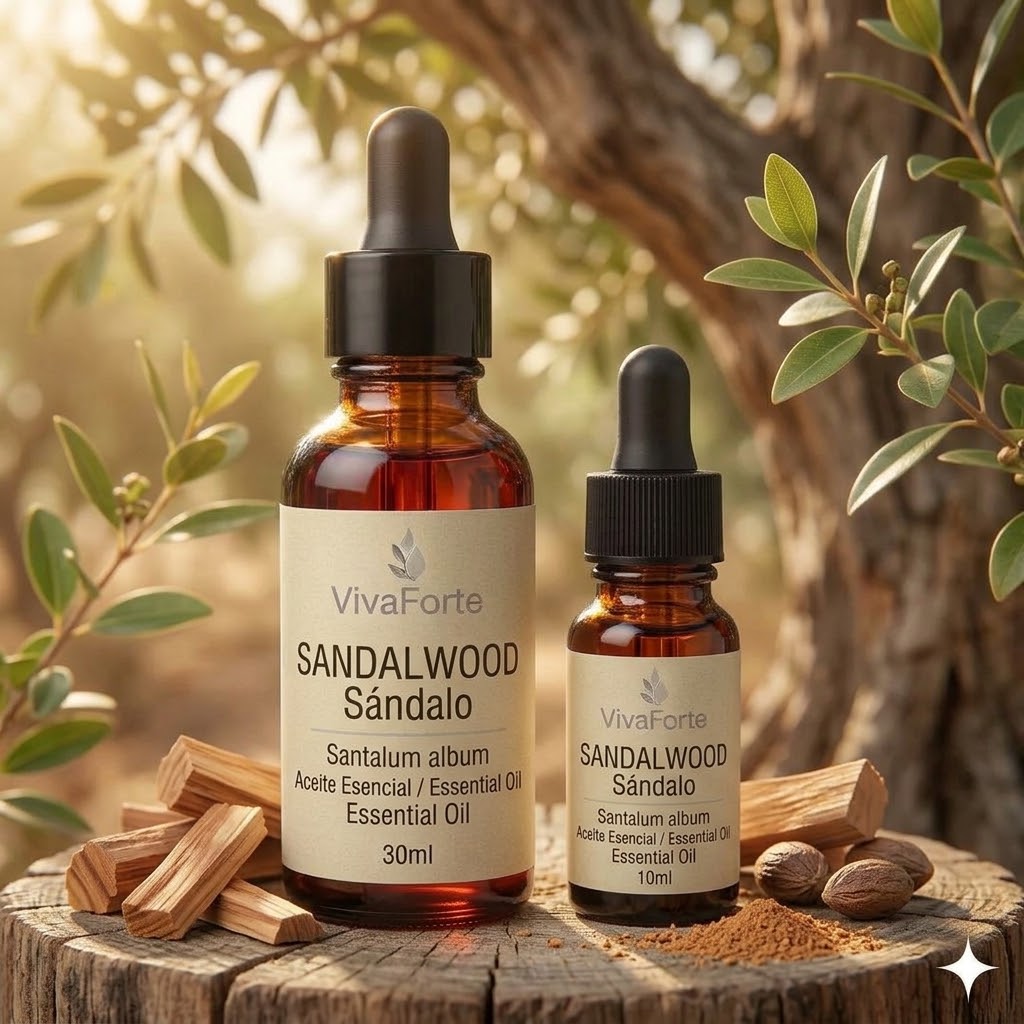
Sandalwood Essential Oil
The Oil of Quiet Devotion
Sandalwood essential oil is a soft, creamy and gently balsamic oil steam-distilled from heartwood, treasured as a calming base note for meditation, skin-care blends and natural perfumery.
Botanical name: Santalum spicatum (Australian sandalwood)
Aroma: Soft, creamy, woody and gently balsamic with a dry, resinous edge
Note: Base
Main growing region: Western Australia
Typically extracted: Steam-distilled from the heartwood
Blends well with: Frankincense, Lavender, Bergamot, Ylang Ylang and Benzoin
Top 3 benefits:
- Meditative stillness: its soft, woody warmth has long been used in contemplative practice and quiet evening rituals.
- Skin-care favourite: traditionally added in small amounts to facial oils and body blends for its smooth, creamy character.
- Perfumer’s fixative: a slow-evaporating base note that helps hold lighter florals and citrus in place.
Safety first: sandalwood may cause an allergic skin reaction in some people, so keep skin use to 1% or less, patch test first, and speak to a healthcare professional before use in pregnancy. Read the full safety information.
What Is Sandalwood Essential Oil?
Sandalwood essential oil is steam-distilled from the heartwood of trees in the Santalum family. The oil in this bottle comes from Santalum spicatum, the Australian species, which grows in Western Australia. Its Indian relative, Santalum album, is the better-known type, and the two have slightly different aromas.
The Australian oil is soft, creamy and gently balsamic, with a drier, slightly resinous edge, and a warmth that develops slowly. Its character comes mainly from alpha-santalol, beta-santalol and farnesol, which make it a valued base note and a natural fixative. Sandalwood trees take many years to develop heartwood worth distilling, which is part of why the oil is considered precious.
Benefits and Traditional Uses
The science: sandalwood has been used in incense and contemplative practice in many cultures for centuries. Many people find its soft, woody scent helps them slow down, although research into aromatherapy is limited.
How to use (the quiet evening): diffuse 2 drops of sandalwood with 3 drops of Frankincense during meditation, yoga or journaling, in a ventilated room.
The science: sandalwood has a long tradition in skin-care and cosmetic preparations, valued for its smooth, creamy aroma. Scientific evidence for skin benefits is limited, so enjoy it as a luxurious ingredient rather than a treatment.
How to use (the facial oil): add 2 drops to 10ml of jojoba or rosehip oil (about 1%). Patch test first, then press gently into the face and neck in the evening, avoiding the eyes.
The science: sandalwood evaporates slowly and has long been used as a fixative in natural perfumery. In a blend it helps lighter top notes such as citrus and florals linger for longer on the skin.
How to use (the personal scent): for a simple roller-ball, add 2 drops of sandalwood to 10ml of carrier oil (about 1%), then your chosen florals or citrus. Patch test first and apply to the pulse points.
How to Use Sandalwood Essential Oil
| Method | Instructions | VivaForte tip |
|---|---|---|
| Diffusion | 2 to 3 drops in an ultrasonic diffuser, in sessions of 30 to 60 minutes. | Sandalwood is subtle, so give it a few minutes to fill the room. |
| Inhalation | 1 drop in the palms, rubbed together and cupped near the nose for a few slow breaths. | Wash your hands afterwards and keep it away from your eyes. |
| Topical | Maximum 1% dilution (about 2 drops per 10ml, or 3 drops per 15ml of carrier oil). | Patch test first and avoid the eyes and broken skin. |
| Skincare | 2 drops per 10ml of jojoba or rosehip oil for a simple evening facial oil. | Keep clear of the eyes and stop if your skin feels irritated. |
| Blending | 1 to 2 drops added to blends as a soft base note. | Pair with frankincense, lavender or bergamot. |
Sandalwood Safety Information
- Dilute and patch test. Use no more than 1% on the skin (about 3 drops per 15ml of carrier oil). Sandalwood may cause an allergic skin reaction in some people, so always dilute, patch test first, and stop using it if irritation occurs. Avoid the eyes and broken skin.
- External and aromatic use only. Do not swallow essential oils.
- Pregnancy, breastfeeding and health conditions. Speak to a healthcare professional before use, particularly if you are pregnant, breastfeeding, have sensitive skin or take regular medication.
- Children. Keep out of reach of children, and do not use on or near the face of babies or young children.
- Pets. Published guidance on pets is limited, so be cautious. Ventilate the room, let animals leave freely, and never apply it to them, particularly cats.
- Keep the bottle fresh. Keep the cap tightly closed and store the bottle somewhere cool and dark to protect the oil.
- Chemical profile. High in alpha-santalol and beta-santalol, with farnesol.
For general guidance on dilution, patch testing and sun safety, read our Essential Oil Safety guide.
History and Heritage
Sandalwood has been prized for thousands of years. In India, the heartwood of Santalum album has long been used in incense, ceremonies and traditional preparations, and the wood has been carved and burned in temples across Asia. Because the trees grow slowly, sandalwood became one of the most valuable aromatic woods in the world.
The Australian species, Santalum spicatum, grows naturally in the drier regions of Western Australia. It is recorded that a sandalwood trade from the region to Asia began in the 19th century. Today Western Australian sandalwood is grown in managed plantations as well as harvested from natural stands, and it is used in incense, skin-care and perfumery.
Sandalwood Essential Oil FAQs
Is sandalwood essential oil safe to use on the skin?
Yes, when diluted. Keep skin use to 1% or less (about 3 drops per 15ml of carrier oil), patch test first, avoid the eyes and broken skin, and stop using it if irritation occurs.
Is sandalwood oil safe in pregnancy or around pets?
Speak to a healthcare professional before using it in pregnancy or while breastfeeding. Guidance on pets is limited, so ventilate the room, let animals leave freely, and never apply it to them.
What does sandalwood smell like and what blends with it?
It smells soft, creamy and woody with a gentle balsamic warmth. It blends well with Frankincense, Lavender, Bergamot and Ylang Ylang.
What is the difference between Australian and Indian sandalwood?
Indian sandalwood (Santalum album) is richer in santalol and has a sweeter, creamier scent. Australian sandalwood (Santalum spicatum) has a drier, slightly resinous character, and is the type used in this oil.
Does sandalwood oil get better with age?
Sandalwood is often described as keeping its aroma well, but it should still be stored with the cap tightly closed, somewhere cool and dark. If it smells sharp or unpleasant, use it only for diffusing, or replace it.
Continue Exploring
- Frankincense: the classic meditation partner, warm and resinous beside sandalwood.
- Benzoin Resinoid: a sweet, vanilla-like base note that deepens sandalwood’s creaminess.
- Ylang Ylang: a lush floral that pairs well with sandalwood in perfumery.
- Essential Oil Safety: dilution, patch testing and sun safety explained.
- All Single Essential Oils: browse the full VivaForte botanical range.